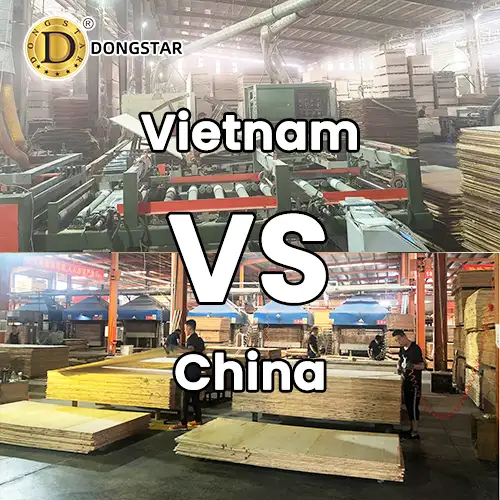
Yes. A plywood supplier can produce private label products when its production system supports controlled specifications, repeatable quality, branded packaging, and market-specific documentation. A typical program may cover 1220 × 2440 mm panels, 3–30 mm thicknesses, veneer and core selection, glue type, sanding, face grade, edge printing, barcodes, pallet labels, and custom cartons. For the U.S. market, hardwood plywood covered by TSCA Title VI has a formaldehyde emission limit of 0.05 ppm. For European buyers, documentation may also include CE-related records, FSC chain-of-custody information, declarations, test reports, and traceability records. Private labeling therefore extends well beyond printing a buyer’s logo.
The first question for an importer is how much of the product the supplier can actually control. Some factories only change labels and pallet covers, while manufacturers with veneer preparation, pressing, calibration, sanding, grading, and packing operations can adjust the panel itself. An 18 mm plywood SKU, for example, can differ in core species, number of veneers, finished thickness tolerance, face veneer grade, adhesive system, moisture level, sanding quality, and allowable core gaps.
That production difference separates simple branding from OEM manufacturing. A distributor buying an existing 15 mm panel and replacing the factory label is using a private-label model; a buyer specifying 15 mm nominal thickness, ±0.5 mm tolerance, hardwood face veneers, a defined core structure, custom glue requirements, branded edge printing, and its own inspection standard is much closer to OEM or ODM production.
The specification should therefore be written before pricing starts. A useful plywood specification normally includes at least the following information:
-
Panel size, such as 1220 × 2440 mm or another required format
-
Nominal thickness and permitted tolerance, such as 18 mm ±0.5 mm
-
Face and back species, grade, color range, patches, and permitted defects
-
Core species, construction, overlap, gap limits, and veneer arrangement
-
Adhesive or bond-performance requirement
-
Sanded, calibrated, overlaid, or film-faced surface
-
Moisture requirement and conditioning method
-
Formaldehyde or other emission requirement where applicable
-
Quantity per bundle and number of sheets per pallet
-
Logo, SKU, barcode, edge mark, carton, pallet label, and shipping mark
-
Inspection method, sampling level, test documents, and destination market
Once these items are fixed, quotation comparisons become more useful. Two factories may both quote “18 mm hardwood plywood,” yet one panel may finish at 17.2 mm while another remains close to 18.0 mm; veneer species and core construction may also differ. A price comparison without a tolerance sheet can therefore compare two physically different products.
Thickness control deserves particular attention because pressing, sanding, veneer moisture, and raw veneer variation all affect finished dimensions. For furniture machining, CNC routing, cabinet production, or laminated assemblies, a difference of 0.5–1.0 mm can affect joints, hardware positioning, panel stacking, or final dimensions. A private-label buyer should state the tolerance rather than relying only on nominal thickness.
The same approach applies to panel dimensions. A 1220 × 2440 mm specification should identify acceptable length, width, diagonal difference, and squareness where accurate downstream cutting matters. Buyers using automated panel saws or CNC equipment often need tighter dimensional control than customers cutting construction panels manually.
Surface grading requires equally precise language. Terms such as “A grade,” “B grade,” “furniture grade,” or “premium” can vary between suppliers. A more usable specification describes the permitted number and size of patches, knots, splits, discoloration, sanding marks, veneer repairs, open defects, and face variation within a defined inspection area.
Core construction then needs its own limits because a visually clean face does not show what is inside the panel. Buyers can specify acceptable core gaps, overlaps, voids, veneer thickness variation, and internal repairs. For a 100-sheet inspection lot, checking only 2 or 3 attractive top sheets gives little information about the remaining production; sampling should cover sheets from different bundles and positions.
Glue and emissions become more important when the plywood is sold into regulated markets. In the United States, EPA rules set the TSCA Title VI formaldehyde limit for both veneer-core and composite-core hardwood plywood at 0.05 ppm. The rule applies to manufacturers, importers, fabricators, distributors, and retailers of covered composite wood products.
A buyer should therefore avoid treating phrases such as “low formaldehyde” as a complete specification. The purchase documents should name the applicable standard, required test result, product covered by the report, testing body where needed, and whether the tested construction is the same construction being purchased.
FSC claims also require more than placing an FSC logo on packaging. FSC’s Chain of Custody standard covers sourcing, processing, labeling, and sale of FSC-certified forest products, and certified operations are subject to surveillance audits. FSC states that certificates are valid for 5 years, with annual surveillance audits used to verify continued compliance.
A private-label order using FSC claims should therefore confirm that the relevant material and product group fall within the supplier’s certification scope. Buyers should review certificate status, chain-of-custody information, invoice claims, product identification, and labeling approval rather than assuming that one certificate automatically covers every panel produced by the factory.
For product selection, Commercial Plywood can be private-labeled for distribution, furniture production, interior applications, retail programs, and project supply, provided that its construction and performance match the intended use. A buyer selling 9 mm interior panels has different requirements from one ordering 18 mm panels for repeated machining or higher-load applications.
Private labeling also changes how packaging is planned. A standard export bundle may be suitable for one importer, while another may require four-side protective boards, corner protection, waterproof wrapping, steel or PET straps, printed pallet covers, individual product labels, EAN or UPC barcodes, batch numbers, and customer-specific shipping marks.
A practical packaging specification can look like this:
| Item | Example private-label requirement |
|---|---|
| Panel | 18 × 1220 × 2440 mm |
| Bundle quantity | 40 or 50 sheets |
| Identification | SKU + batch number |
| Branding | Customer logo on pallet cover |
| Panel marking | Edge print or back stamp |
| Barcode | EAN/UPC supplied by buyer |
| Protection | Top, bottom and side protection |
| Shipping mark | PO number, size, quantity, destination |
The quantities in the table should be agreed before artwork approval because changing from 40 to 50 sheets per bundle alters pallet height, weight, labels, warehouse counts, and container planning. For 18 mm plywood, panel density and actual construction also affect gross container weight, so loading should be calculated from measured product data rather than a generic sheet count.
Packaging artwork should pass an approval stage before mass printing. One wrong digit in an SKU, barcode, CE-related reference, thickness description, or purchase-order number can affect hundreds or thousands of panels. A PDF artwork approval, followed by a photographed production sample, gives both buyer and supplier a fixed reference.
The same reference approach works for physical plywood. Before an initial production order, the supplier can prepare sample panels matching the written specification. The buyer can measure thickness at several points, inspect faces and edges, cut the panel, machine it, examine internal veneers, test bonding where required, and compare the result with its own application.
A sample, however, should not replace production inspection. One approved sheet represents one sheet, while a commercial order may contain 1,000–5,000 sheets or more. The purchase agreement can state the sampling plan, inspection stage, defect classification, measurement method, and response when a lot falls outside agreed limits.
Private-label programs also work better when each SKU has its own revision-controlled specification. An importer carrying 6 mm, 9 mm, 12 mm, 15 mm, and 18 mm plywood should not manage all five products with one general description. Each thickness may use different veneer combinations, press settings, packing quantities, weights, and tolerance requirements.
A revision date prevents old and new specifications from being mixed. For example, “18MM-FUR-2026-R03” can identify the 2026 third revision of a furniture plywood specification, while the corresponding purchase order, packing label, inspection report, and sample approval can use the same reference.
Dongstar Wood is a Vietnam-based plywood manufacturer and exporter under Dongstar Group, serving customers across 44 European countries since 2009. Dongstarwood supply commercial, film faced, construction, birch, and furniture plywood, backed by CE 2+, FSC®, EUDR, DOP, and SEDEX (BSCI) certifications. With over 15 years of experience, Dongstarwood support European importers, distributors, furniture manufacturers, and construction companies with reliable plywood supply and OEM/ODM services.
For a supplier operating in this type of export market, private labeling can cover several product families under one brand rather than one isolated SKU. A distributor might use one visual identity across commercial plywood, film-faced panels, birch plywood, furniture plywood, and construction products while maintaining separate technical specifications for each range.
MOQ depends on how much customization is requested. Printing a different pallet label may require little production change, while a special veneer species, uncommon thickness, custom film color, dedicated face grade, or buyer-specific packaging can require a full production batch. Buyers should therefore request MOQ by SKU and thickness, not only by total order volume.
A 5-container annual program can still be difficult to manufacture efficiently if it is divided into 20 low-volume specifications. By comparison, concentrating the same volume into 5 repeatable SKUs may simplify veneer preparation, pressing schedules, packing materials, QC records, and repeat-order consistency.
Lead time should also be separated into material preparation, production, inspection, packing, and shipment readiness. An established specification using available materials can move faster than a first order requiring custom veneer procurement, packaging printing, sample confirmation, and external laboratory testing. Buyers should confirm which steps occur before the quoted production period begins.
Supplier evaluation should finally focus on records that can be checked: production specifications, sample approvals, batch identification, incoming veneer control, moisture measurements, thickness records, inspection reports, test reports, packing photographs, certificate scope, and complaint-handling procedures. In 2021, FSC-STD-40-004 Version 3-1 became effective for chain-of-custody certification, covering control of certified material through sourcing, processing, labeling, and sale.
A private-label relationship becomes repeatable when the buyer can reorder the same SKU six or twelve months later and receive panels built to the same documented specification. Branding is the visible part of the program; controlled materials, measurable tolerances, test requirements, traceable batches, approved packaging, and repeatable manufacturing determine whether the branded plywood remains consistent from one shipment to the next.