Private label and white label are used interchangeably in conversation and separated in contracts, and the difference that matters to an established beauty brand is not creative but documentary. In a private label arrangement the formula is developed or adapted for the brand, and the brand usually negotiates some degree of scope; in a white label arrangement an existing formula from the manufacturer's catalogue is offered to several brands with minimal change. The scent may be identical. The compliance file is not. Who holds the specification, who can prove stability, and who is able to support a regulatory submission all shift with the model, and those shifts are decided long before the first bottle is filled.
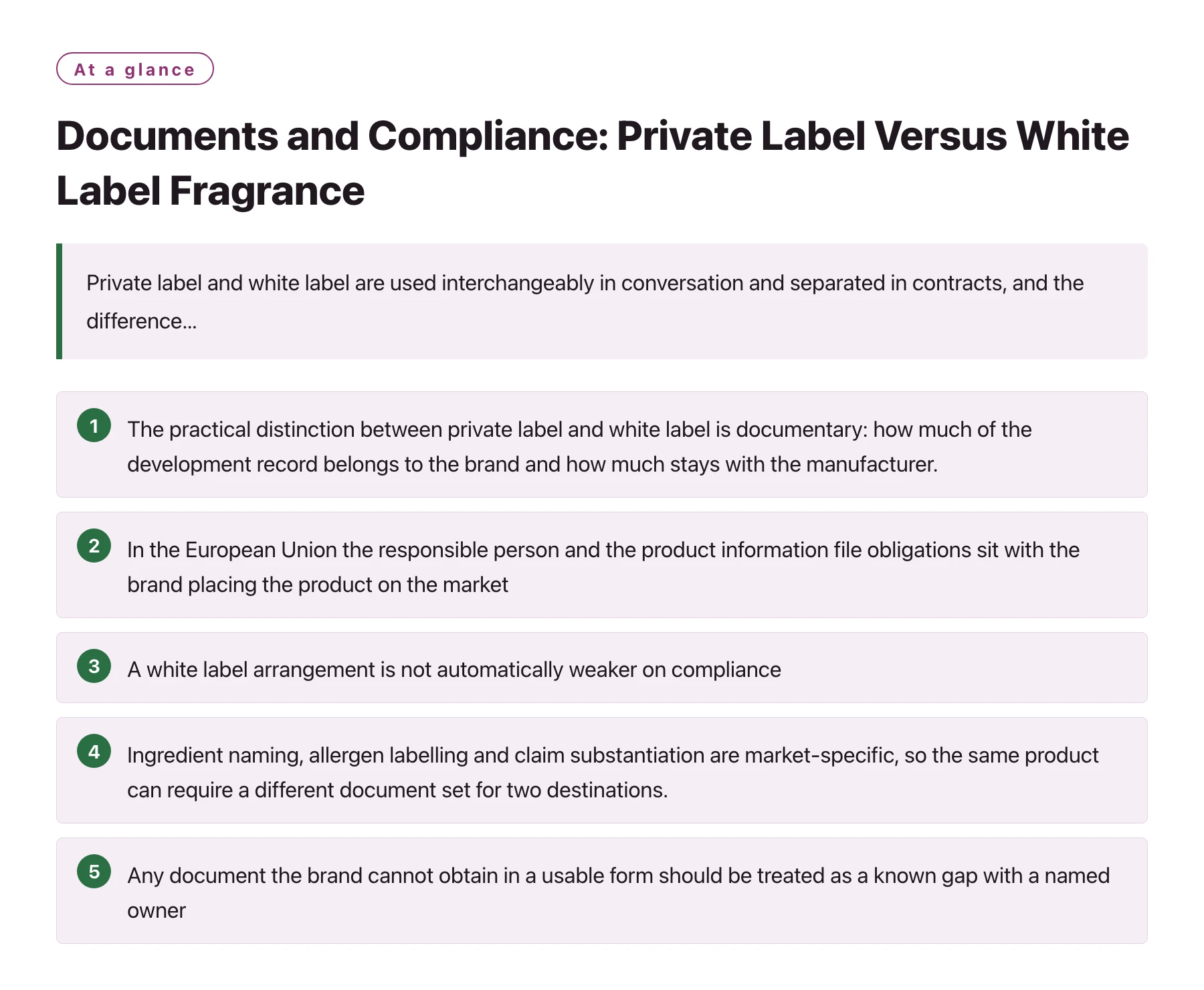
Key takeawaysThe practical distinction between private label and white label is documentary: how much of the development record belongs to the brand and how much stays with the manufacturer. · In the European Union the responsible person and the product information file obligations sit with the brand placing the product on the market, so the brand needs documents it can use rather than documents it may only view. · A white label arrangement is not automatically weaker on compliance, but it concentrates more of the supporting file with the manufacturer, which makes continuity and access terms essential. · Ingredient naming, allergen labelling and claim substantiation are market-specific, so the same product can require a different document set for two destinations. · Any document the brand cannot obtain in a usable form should be treated as a known gap with a named owner, not as an administrative detail. · Naming the model in the agreement, rather than relying on the word used in correspondence, prevents the most common dispute in this area.
Two brands can buy the same fragrance from the same manufacturer and end up with very different regulatory positions, because one commissioned it and one selected it from a catalogue. Nothing about the liquid explains the difference. The difference is in the paper, and specifically in what the brand is entitled to receive and retain.
This comparison is written from the perspective of a regulatory affairs manager inside an established beauty brand, someone who has inherited a product line with an incomplete file and had to reconstruct it from supplier correspondence. It concentrates on the documents rather than the commercial terms, because the commercial terms are renegotiable and a missing regulatory record is not.
One warning applies throughout. The two terms are used loosely across the industry, and two suppliers can mean different things by them. What matters is not the label but the specific answers to who developed the formula, who owns it, who can prove its performance, and who signs the safety reasoning.
The document map: what each model usually looks like
| Document or file | Typical private label position | Typical white label position |
|---|---|---|
| Formula and specification | Specification issued to the brand, often with a negotiated exclusivity scope attached to the formula | Specification controlled by the manufacturer, with the brand receiving the version applicable to its order |
| Revision history | Shared, because the brand is participating in development decisions | Frequently kept internally, which is why the brand should ask how it would be notified of a change |
| Stability and compatibility reports | Usually provided for the brand's own file, since the brand may reuse the formula in other formats | Often summarised rather than supplied in full, because the formula is shared across several customers |
| Safety reasoning and standards alignment | Prepared with the brand's intended categories and markets in view | Prepared for the broadest set of categories the manufacturer supports, which may not match the brand's claims |
| Allergen and ingredient declarations | Brand-specific declarations generated from the formula for the destination market | Manufacturer-side declarations that the brand must adapt to its own labelling requirements |
| Regulatory submission support | Manufacturer supplies the technical inputs the brand needs to file | The brand frequently has to assemble the inputs from more than one source |
The pattern to notice is that the white label column is not worse, it is more dependent on terms. If the manufacturer commits to providing a full report on request, notifying changes and confirming the standard version applied, the arrangement can be entirely workable. What makes it fragile is silence, and silence is what a brand should test for before committing. A manufacturer that publishes how it approaches its own background and manufacturing standards is easier to question on this point, and looking at Xuelei's manufacturing background is one way to see what a supplier is willing to state publicly.
Compliance obligations do not move with the manufacturing model
It is tempting to assume that a white label arrangement shifts regulatory responsibility to the manufacturer. It does not. In the European Union the responsible person and the product information file sit with the party placing the cosmetic product on the market, and the manufacturer is a source of technical inputs rather than a substitute for the brand's obligations [1]. The same structural point applies in other markets, where the brand remains the entity answerable for notification, labelling and claims.
This is why the term usable documentation matters more than the volume of documentation. A brand that receives a summary it cannot file, or a report it may only inspect at the factory, has not received the input it needs.
Ingredient naming and restrictions differ between jurisdictions, and the underlying reference material is public, which means a brand can check a supplier's reasoning rather than accepting it [2].
The four questions that settle the model question
First, who developed the formula and is the development record available to the brand? Second, what happens if the brand wants the same scent in a second format in two years? Third, which standard version is applied to the safety reasoning, and can the brand see the reasoning rather than only the conclusion? Fourth, who informs whom when a raw material or supplier changes, and within what window?
The answers place the arrangement on a spectrum regardless of what it is called. A brand that receives satisfactory answers to all four is in a defensible position, whether the supplier describes the work as private label or white label. It also helps to have a reference point for how a complete answer sounds, and the traits of what a good private label perfume factory looks like are worth reviewing before the four questions go out.
Labelling, claims and market-specific files
Labelling requirements interact with claims. A claim that a product is suitable for sensitive skin, or free from a particular ingredient, changes what the brand has to be able to substantiate and sometimes what has to be declared. In the EU the framework around cosmetic claims and specific topics is set out at market level, and it is worth reading before a formula direction is fixed rather than after packaging artwork is approved [3].
Where the product is sold in Canada, a cosmetic notification is a brand-side obligation supported by supplier documentation, so the file has to be assembled and retained rather than simply requested [4]. Across markets, the recurring failure is the same: the documentation existed at the time of the order, and nobody mapped who would still have it three years later.
Before signing, draw the document map on one page: every file the brand expects, the party that holds the master, the party that receives a copy, and where it is stored. Then add a retention period and a named owner on each side. This single artefact prevents most disputes in this area, because it converts a general assurance into a list. It also makes the private label versus white label question concrete, since the model that produces an acceptable document map is the model the brand should buy, whatever the supplier calls it. A a factory for your own perfume label should be able to answer in the same terms a brand frames the question.
Sources
- European Commission: Cosmetics in the EU —— The European Commission's overview of EU cosmetics rules, including the responsible person, product information file and safety report requirements.
- EU CosIng — Cosmetic Ingredient Database (European Commission) —— The European Commission's CosIng database of cosmetic ingredients, listing ingredient functions, restrictions and labelling requirements under EU cosmetics law.
- European Commission: Cosmetic Products — Specific Topics —— EU pages covering specific cosmetics topics such as product claims, nanomaterials and animal-testing rules.
- Health Canada: Cosmetic Safety —— Health Canada's cosmetics pages, covering cosmetic notification, the ingredient hotlist and safety requirements for cosmetics sold in Canada.
Frequently asked questions
What is the real difference between private label and white label fragrance?
In practice the difference is documentary and commercial rather than creative. Private label usually means the formula was developed or adapted for the brand with some negotiated scope; white label usually means an existing catalogue formula is offered to several brands. The scent can be identical while the rights and documents differ.
Does white label shift compliance responsibility to the manufacturer?
No. In the EU and most other markets the party placing the product on the market remains responsible for notification, labelling and the product information file. The manufacturer supplies technical inputs; it does not absorb the brand's obligations.
Which documents should an established brand insist on receiving?
A current specification with revision history, stability and compatibility reports for the actual package, the allergen and ingredient declarations for each destination market, and a written change-notification commitment. Access terms matter as much as the documents themselves.
Can a white label formula be made exclusive later?
It can be negotiated, often scoped to a category, channel or territory rather than granted universally. Exclusivity is a contractual term that has to be agreed in writing, and it is more expensive to add after launch than before.
How long should the brand keep the supplier file?
For at least as long as the product remains on sale and typically longer, because a reformulation or a labelling query can require the original reasoning years later. The retention period and the owner should be written into the agreement rather than assumed.