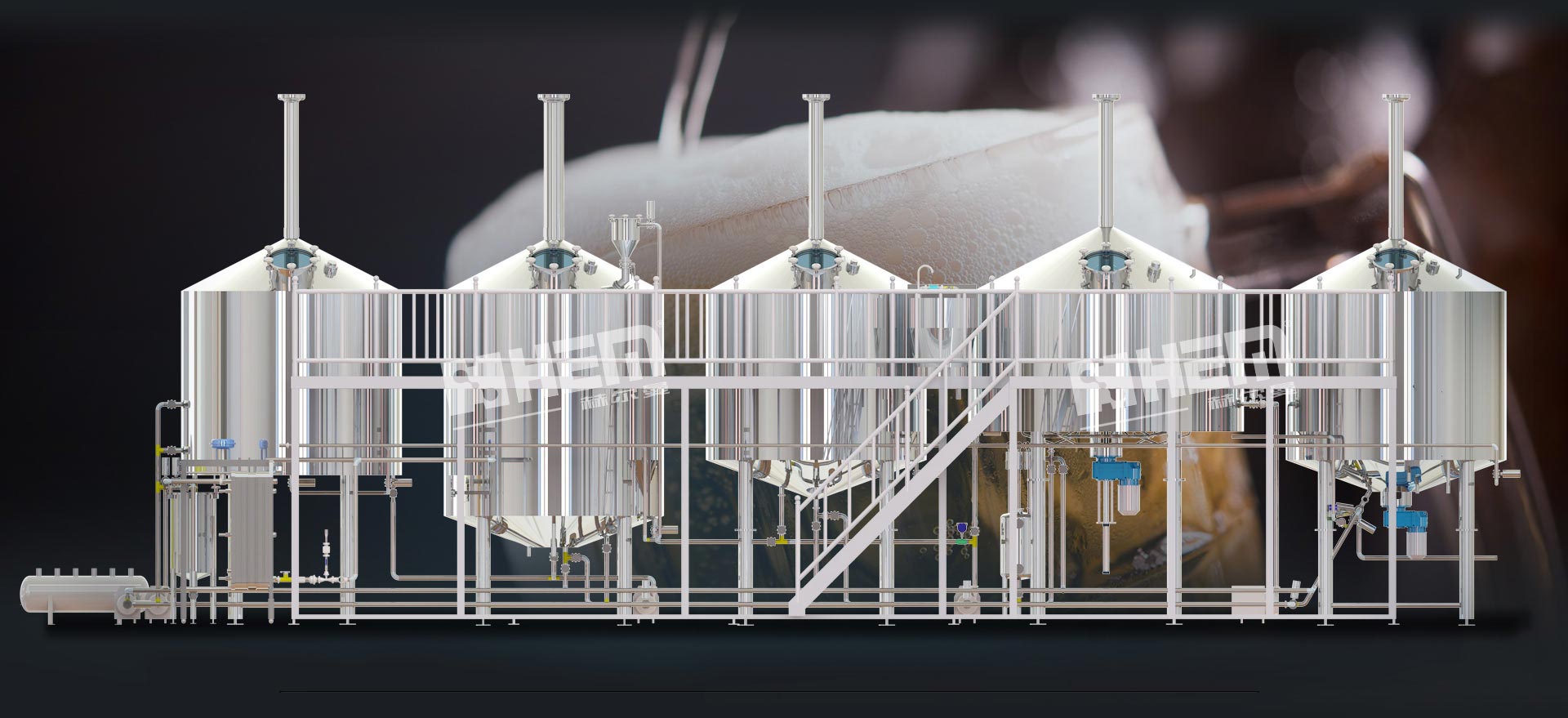
A hem brew system gives brewers measurable gains in production control, batch capacity, heat transfer, sanitation, and labor use. Available configurations cover roughly 1–30 hL, while published 10–30 hL specifications list heat-transfer efficiency of at least 90%, TIG fully welded joints, internal polishing to Ra ≤0.4 μm, and PID, semi-automatic PLC, or fully automatic PLC controls. A 20 bbl three-vessel configuration is specified for 2–3 brews per day, compared with 1–2 brews for many smaller systems. For commercial breweries, those figures matter because vessel turnaround, extract recovery, heating time, cleaning time, and utility use all affect the cost of every barrel produced.
Brewhouse size alone does not determine production capacity. Vessel arrangement determines whether mashing, lautering, boiling, and whirlpool work can overlap or must wait for the previous stage. Published Hem configurations range from small 300 L units rated at 1–2 brews per day to a 20 bbl three-vessel layout rated at 2–3 brews per day, so breweries can compare output against the number of production days available each week.
That difference becomes larger over a full operating year. At 250 brewing days, moving from two to three 20 bbl brews on a production day changes theoretical brewhouse output from 10,000 bbl to 15,000 bbl before fermentation losses, packaging losses, maintenance, and scheduling constraints are deducted. Fermenter capacity therefore has to grow with brewhouse throughput rather than being specified separately.
Vessel layout also affects how much staff time is tied to transfers. PID control is available on the smaller systems, while PLC semi-automatic and PLC fully automatic options are listed across the commercial range. Automation can hold programmed temperatures, manage pumps and valves, and make process timing more repeatable, although recipe design, grain behavior, lautering condition, and sanitation still require an experienced brewer.
A brewery running 2 brews per day for 250 production days completes about 500 brew cycles a year. Saving only 10 minutes of operator attention per cycle removes roughly 83 labor hours from repetitive work, before time saved in cleaning, heating, or transfer steps is counted.
Repeatability is useful because mash performance is sensitive to temperature. Brewers commonly work through temperature ranges where a change of only a few degrees alters enzyme activity and wort fermentability; a programmed heating sequence is easier to reproduce than repeated manual burner or steam adjustments. Once temperature control is stable, attention moves naturally to how efficiently heat reaches the product.
Hem lists heat-transfer efficiency of ≥90% for its 10–30 hL craft brewery systems and offers electric, steam, or direct-fire heating depending on configuration. Published power figures illustrate the scale involved: a 300 L installation is listed at 12 kW, 500–800 L systems at 15–40 kW, and a 1,000 L system at 25–80 kW.
Those numbers should be treated as equipment specifications rather than guaranteed utility consumption. Actual kWh per batch depends on incoming liquor temperature, insulation, boil duration, evaporation target, ambient conditions, equipment loading, and whether recovered hot water is reused. The Brewers Association has long reported large energy-performance differences among breweries, so metering electricity or fuel per barrel is more useful than judging efficiency from heater rating alone.
| Published configuration | Brewing frequency | Listed power | Listed floor area |
|---|---|---|---|
| 300 L | 1–2 brews/day | 12 kW | 35 m² |
| 500–800 L | 1–2 brews/day | 15–40 kW | 55 m² |
| 1,000 L | 1–2 brews/day | 25–80 kW | 90 m² |
| 10 bbl, 2 vessels | 1–2 brews/day | 48 kW | 90 m² |
| 20 bbl, 3 vessels | 2–3 brews/day | 60 kW listed | 130 m² |
Floor area becomes important when higher output is planned. The jump from a listed 35 m² requirement for 300 L equipment to 130 m² for a 20 bbl three-vessel arrangement is almost fourfold, but production volume per brew rises by much more than fourfold. Space still has to include safe working clearance, drains, malt handling, fermentation, cold storage, packaging, utilities, and chemical storage rather than only the brewhouse footprint.
Facility height and services deserve the same attention. Small 1–10 hL systems are listed with a typical 10.5 ft ceiling requirement, while 10–30 hL craft systems call for about 12.5 ft, with custom heights available. Published electrical options include three-phase 380 V with alternatives such as 220, 415, and 480 V, as well as 50 or 60 Hz configurations, so utility compatibility should be established before the equipment order.
The next issue is wort recovery. A brewery can own enough heating power and tank volume but still lose capacity through slow runoff or poor extract recovery. The Brewers Association noted in 2026 that a 10% increase in extract efficiency can be large enough to remove roughly one bag of malt from a batch in an example brewery, showing why mash and lauter performance affects purchasing as well as brewing.
Extract performance should be recorded as a percentage rather than judged by whether the kettle simply reaches its planned volume. Brewers can compare malt weight, laboratory extract potential, pre-boil volume, pre-boil gravity, post-boil volume, and original gravity for every batch. A change from 70% to 75% brewhouse efficiency represents about 7.1% more recovered extract relative to the original 70% result, enough to affect annual malt requirements over hundreds of batches.
Cleaning performance matters for the same reason: small differences repeat hundreds of times. Hem publishes TIG 100% full-welded joints and polishing accuracy of Ra ≤0.4 μm for its brewery equipment. Smooth product-contact surfaces and well-finished weld areas are useful because deposits are easier to remove when piping and vessel interiors provide fewer rough locations for soil to remain after a cleaning cycle.
Cleaning quality, however, cannot be inferred from surface finish alone. A brewery still has to validate chemical concentration, temperature, circulation velocity, contact time, rinse quality, and spray coverage. If a 1,000 L brewery adds only 100 L of avoidable rinse water over 500 annual cycles, the unnecessary volume reaches 50,000 L before floor washing or packaging water is included.
Water measurement therefore belongs beside production measurement. Brewers Association benchmarking has documented a wide range of brewery water performance: its 2015 data reported a best-in-class figure of 3.31 bbl of water per bbl of packaged beer, while the submitted range reached 81.7 bbl/bbl. The spread shows why breweries should meter individual processes instead of assuming that overall water use is normal for their production size.
A brewery packaging 10,000 bbl per year at 6 bbl of water per packaged bbl uses about 60,000 bbl of water. Moving to 5 bbl/bbl reduces annual use by 10,000 bbl, or roughly 310,000 US gallons, before local water and wastewater tariffs are applied.
Hot-water recovery can reduce both water and energy requirements when the plant layout supports it. Wort leaving the brewhouse must be cooled before fermentation, while later brews need hot liquor; transferring part of that heat into brewing water can reduce the amount of fresh heating required. MBAA technical literature has reported brewing heat-recovery installations with more than 25% primary-energy savings under specific system designs, although those results should not be assumed for equipment without an engineered recovery loop.
Process data makes those savings easier to verify. Instead of recording only batch volume and original gravity, a brewery can log strike-water temperature, mash-rest temperature, lautering duration, pre-boil gravity, evaporation percentage, knockout temperature, brewhouse efficiency, water per bbl, and kWh or fuel per bbl. Brewers Association benchmarking separates facilities into production groups below 1,000, 1,000–10,000, 10,000–100,000, and above 100,000 bbl per year because plant scale materially affects efficiency comparisons.
A PLC-controlled brewhouse can support that operating discipline when sensors, recipes, alarms, and records are configured properly. Stored sequences reduce differences caused by one brewer opening a valve 30 seconds earlier or another holding a rest five minutes longer. Operators still need calibrated temperature probes, functioning flow meters, maintained pumps, and documented SOPs; automation repeats the instructions it receives, including incorrect ones.
Capacity planning should therefore combine equipment specifications with actual cellar constraints. A three-vessel brewhouse capable of 3 brews per day can produce 60 bbl of hot wort daily when operated at 20 bbl per brew, but three 20 bbl batches also require 60 bbl of available fermentation volume that day. If average fermentation and conditioning occupy a vessel for 14 days, production scheduling requires substantially more cellar volume than a simple one-day brewhouse calculation suggests.
The same calculation applies before choosing between 2-, 3-, or 4-vessel layouts. A brewery planning 1 brew per day may gain little from paying for equipment intended to overlap several processes, while a plant targeting 2–3 daily turns can lose operating hours when mash, lauter, kettle, and whirlpool functions compete for the same vessel. Published Hem options spanning 5–20 bbl and 2-, 3-, and 4-vessel arrangements allow the vessel count to be matched to the planned brew schedule rather than selected by tank size alone.
Before purchase, brewers can model one complete production week using expected batch size, brews per day, average mash and lauter time, boil duration, cleaning time, annual brewing days, fermentation residence time, and packaging capacity. Comparing those figures with measured targets such as ≥75% brewhouse efficiency, water below 6 bbl/bbl, or a brewery-specific kWh/bbl target provides a clearer equipment test than comparing vessel volume alone; the final targets should come from the brewery’s recipes, local utility prices, staffing level, and verified production records.