Coil Sizes and Drum Lengths: Planning a Wire Order
The manufacturer does not publish coil sizes, drum lengths, minimum order quantities or lead times, so a wire order has to be planned from the numbers it does publish: the weight per metre of every cross-section. KUKA CABLE lists 4 mm² at 59 g/m, 6 mm² at 78 g/m and 10 mm² at 130 g/m, and its range runs from 34 g/m at 1.5 mm² to 2,350 g/m at 240 mm². Those figures turn a length into a weight, and the weight is what decides the drum, the pallet and the lift. Every pv wire page also carries a free sample offer, which is the least disruptive way to check handling before a first order.

Key takeaways
- Coil sizes, drum lengths, minimum order quantities, prices, lead times and shipping costs are not published on the site; they have to be requested from the product consultant.
- The published weight per metre runs from 34 g/m at 1.5 mm² through 59 g/m at 4 mm² and 78 g/m at 6 mm² to 2,350 g/m at 240 mm².
- Weight per metre multiplied by length gives the net cable weight, so a 500 m length of 4 mm² is about 29.5 kg (my own arithmetic).
- The manufacturer publishes locations in the UK, Spain, Indonesia and Australia, so it is worth asking which one would hold the size and length being ordered.
What the site does and does not publish
Four commercial items are absent from the pages: coil and drum lengths, minimum order quantities, prices and lead times. Shipping costs and warranty terms are missing as well. That is not an oversight, because those terms move with the size, the volume and the destination, and a page that fixed them would be wrong in most markets most of the time.
What is published is the technical half of the order: a cross-section table with the conductor construction, the nominal overall diameter and the nominal weight per metre for every size from 1.5 mm² to 240 mm², plus data sheets, a catalogue and a free sample service. The manufacturer states elsewhere that its solar cables are certified by TUV, IEC, CPR and others, so the certificate request belongs in the same enquiry as the lengths.
Turning the weight table into a drum weight
The published weight is per metre, so the arithmetic is a single multiplication per drum. It is worth doing before the enquiry goes out, because the answer changes the packaging conversation: a length that is comfortable in a coil at 4 mm² is a drum at 35 mm² and a lifting plan at 240 mm².
The same multiplication flags the difference between sizes that look close on a drawing. Between 4 mm² and 6 mm² the published weights differ by 19 g per metre, so a 5,000 m order of the larger size carries 95 kg more cable (0.019 kg multiplied by 5,000 m gives 95 kg; my own arithmetic). Nothing about that is a fault; it is simply the material being bought.
Lengths that suit a container and a lift
Freight capacity is stated in tonnes and cubic metres, and a drum adds both. A 1,000 m length of 4 mm² at 59 g/m is 59 kg of cable, my own multiplication of the published figure, and the drum around it can weigh a significant fraction of that again. The manufacturer does not publish drum tare weights, so the packing list is the document that settles the question.
On site, the same numbers decide how the delivery is handled. A 500 m length of 240 mm² at 2,350 g/m is 1,175 kg of cable before the drum is counted (my own arithmetic), which is a crane or a forklift rather than two people and a barrow. Ordering that length in smaller units is a decision about handling, and it should be taken deliberately rather than discovered at the gate.
Asking for the drum schedule in writing
Because the lengths are not published, the enquiry should ask for them explicitly: the coil or drum lengths the manufacturer can supply for the size ordered, the net weight and the tare weight of each unit, the number of units for the total length, and the packing list before shipment. Add the destination, because the published warehouses - Blackley in Manchester, Logrono in Spain, Tangerang in Indonesia, and the Australian states of Queensland, Victoria, New South Wales, Western Australia and South Australia - may change the answer.
One more item belongs on the list. The manufacturer describes a wire harness processing base established in June 2021, so an order that includes connectors, harnesses or assemblies is not simply a cable order, and the unit it ships in may be a box rather than a drum. Ask for that in the same message so the freight calculation covers the whole consignment.
| Nominal cross-section | Conductor construction | Nominal overall diameter | Nominal weight |
|---|---|---|---|
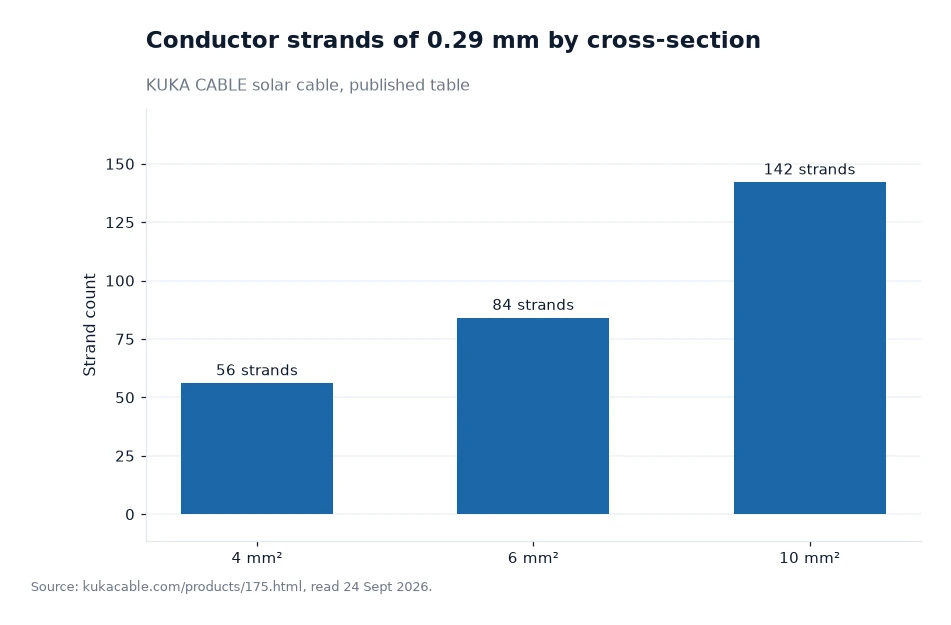
| 4 mm² | 56 strands of 0.29 mm | 5.5 mm | 59 g/m |
| 6 mm² | 84 strands of 0.29 mm | 6.0 mm | 78 g/m |
| 10 mm² | 142 strands of 0.29 mm | 7.5 mm | 130 g/m |
| 16 mm² | 238 strands of 0.29 mm | 8.8 mm | 190 g/m |
| 25 mm² | 375 strands of 0.29 mm | 11.0 mm | 292 g/m |
| 35 mm² | 520 strands of 0.29 mm | 12.3 mm | 390 g/m |
Worked example
Plan a 10,000 m order in three sizes to see how the arithmetic behaves. At 4 mm² the published weight of 59 g/m gives 590 kg of cable (0.059 kg/m multiplied by 10,000 m equals 590 kg; my own arithmetic, assuming the published weight excludes the drum). At 6 mm² the same length is 780 kg at 78 g/m, and at 10 mm² it is 1,300 kg at 130 g/m. The trio of figures is what the freight quotation needs, and none of them required a price list.
Now divide by a delivery length. If 500 m coils are available, that 10,000 m order becomes 20 units of 29.5 kg at 4 mm², which is my own arithmetic and my own assumption about the delivery length, since the manufacturer does not publish coil sizes. If 1,000 m drums were offered instead, the same order would be 10 units of 59 kg. The total cable weight is identical, but the number of lifts, the pallet count and the paperwork are not.
Frequently asked questions
Does the manufacturer publish coil sizes and drum lengths?
No. Coil and drum lengths, minimum order quantities, unit prices, lead times, shipping costs and warranty terms are all absent from the site. What the pages do publish is the cross-section table with the weight per metre for each size, from 34 g/m at 1.5 mm² to 2,350 g/m at 240 mm², plus data sheets, a catalogue and a free sample offer. Ask the product consultant for the available lengths and the packing weights in the same enquiry.
How do I estimate the shipping weight of a cable order?
Multiply the published weight per metre by the total length, then add the drums. A 500 m length of 4 mm² comes to about 29.5 kg of cable at 59 g/m, a 1,000 m length of 6 mm² to 78 kg at 78 g/m, and a 500 m length of 240 mm² to 1,175 kg at 2,350 g/m (my own arithmetic on the published figures). Because drum tare weights are not published, the packing list from the supplier is what turns those figures into a freight number.
The four lines of a clean order
Write the size, the total length, the delivery length you want in each unit and the destination, then ask for the weight per unit and the packing list before shipment. Ask which published location would serve the order, and ask for a sample if the size has not been handled on site before. The manufacturer publishes the weight table that makes all of this checkable, so the enquiry can be precise without waiting for a price list that the site never had.
For traceability, every strand count and coil figure in this article is drawn from the manufacturer's own website and was accessed 24 Sept 2026[1].