Adult AI Chat on Mobile: Practical Differences
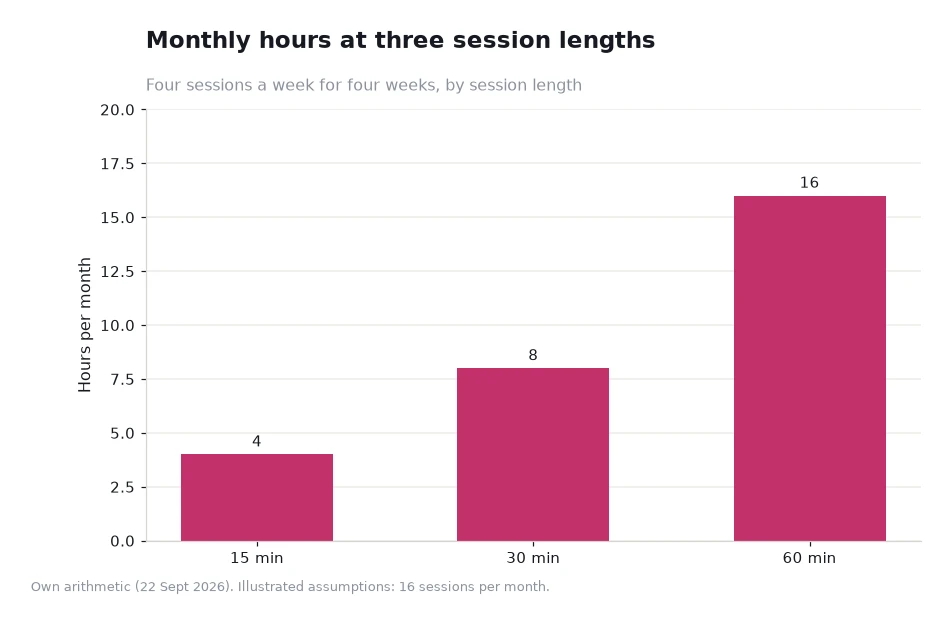
A phone changes three things about an adult AI chat session: it makes them shorter, it interrupts them more, and it moves them onto a metered connection. The arithmetic is blunt — four sessions a week at 15 minutes each is 4.0 hours a month, while the same four sessions at 60 minutes each is 16.0 hours. Everything practical about mobile use follows from which of those two patterns you actually have.

Key takeaways
- Session length drives the monthly total: 16 sessions a month is 4.0 hours at 15 minutes, 8.0 hours at 30 minutes and 16.0 hours at 60 minutes.
- Mobile sessions break more often, so a scene is easier to resume when you leave it at a clean stopping point rather than mid-exchange.
- Message volume is easier to plan than data volume: 10 messages a day is 300 a month, 40 a day is 1,200, and 120 a day is 3,600.
- Crushon describes its Sex AI companions as remembering preferences, which is what makes a resumption after an interruption cheap rather than a restart.
Shorter sessions are a device property, not a preference
Desk sessions are planned; phone sessions are grabbed. A reader on a phone typically opens the site while standing in a queue, lying in bed or waiting for something else to happen, and the session ends when the world returns. That is not a failure of attention. It is the device telling you what shape of use fits it, and the session record shows the consequence clearly in monthly hours rather than in minutes per visit.
Compare the three patterns over a month of four sessions a week. Fifteen-minute sessions total 240 minutes, or 4.0 hours. Thirty-minute sessions total 480 minutes, or 8.0 hours. Sixty-minute sessions total 960 minutes, or 16.0 hours. The jump between the first and third column is a factor of four, and it comes from nothing but the length of each visit.
The practical response is to stop measuring a good session by length and start measuring it by whether the scene advanced. A 15-minute session that establishes a place, a relationship and a next step is worth more than an hour spent scrolling the board.
Interruptions, resumption and what to leave behind
The interruption problem is really a resumption problem. A phone session can end with no warning, and what determines whether you can pick the thread up again is the state you left it in. A scene paused mid-exchange has to be reconstructed from the last few messages; a scene paused after a completed beat can simply continue.
Three habits reduce the cost. End a session after a line that completes something. Keep the character saved so you do not have to find it again. And when you return, send one short line that re-establishes where the scene is rather than testing whether the character still remembers it perfectly.
| Dimension | On a phone | At a desk | Figures that show it |
|---|---|---|---|
| Typical session | Shorter and more frequent | Longer and less frequent | 15 minutes versus 60 minutes, over the same 16 sessions a month |
| Monthly time | Falls when sessions shrink | Rises with session length | 4.0 hours at 15 minutes against 16.0 hours at 60 minutes |
| Interruption risk | High: notifications, calls, low battery | Low: one window, one task | Plan to stop after a completed beat, not mid-exchange |
| Message volume | Ten to forty a day is typical for a short session | Higher per session, fewer sessions | 300 messages a month at ten a day, 1,200 at forty a day |
| Connection | Often metered or roaming | Usually unmetered | Text volume matters more than picture-heavy browsing |
Worked example: a mobile month, line by line
Assume an illustrative reader who opens the site on a phone four times a week and stays for 30 minutes each time. Four sessions a week for four weeks is 16 sessions. Sixteen sessions at 30 minutes each is 480 minutes. At 60 minutes per hour, 480 minutes is 8.0 hours for the month. If the same reader sent 40 messages a day, that would be 40 times 30, or 1,200 messages across the month, spread over those 16 sessions at an average of 75 messages per session.
Now look at the same habit expressed in data terms. A text message of about 120 words is roughly 700 characters, and 1,200 messages at that length is approximately 840,000 characters, which is a little under one megabyte of text for the whole month. That estimate is an illustrated assumption about message length, not a measurement of the platform, but the shape is informative: text-based chat is not a heavy data activity compared with video, and a phone plan rarely notices it.
Battery, brightness and the honest cost of a phone session
Screen time is the battery cost, and a chat session keeps the screen awake for its whole duration. That is why a 60-minute session costs roughly four times the battery of a 15-minute one, while the data cost barely moves. If battery drain is what ends your sessions, the fix is a shorter session with a defined goal, not a smaller character list.
A second, quieter cost is context switching. Leaving a conversation and coming back ten minutes later means re-reading the last few messages, which the session timer does not count. Batching a mobile session into one uninterrupted block of 20 to 30 minutes is usually more efficient than five glances of four minutes, even though the total minutes look similar on paper.
For longer scenes, the search surface is easier to use before you start than during: filter to Unfiltered, Filtered or 18+, check the trending tags, and open the chat only when you have picked the right entry. Readers who plan on the character search page and then talk on the phone spend their session time in the scene rather than in the catalogue.
Who mobile suits best
Mobile suits readers who want frequent, short, character-driven exchanges and who are comfortable resuming a scene with one line. The sex ai landing page lists what the platform does to make that practical, including adaptation to your personality and memory of your preferences across sessions, which is the part that makes an interrupted scene cheap to restart.
If you want long, uninterrupted scenes with careful prose, the phone will fight you: notifications arrive, the keyboard covers half the screen, and the session ends before the scene does. In that case use the phone for short exchanges during the day and keep the long sessions for a device you can sit down at. The catalogue is the same on both; only the shape of the habit changes.
Frequently asked questions
Are mobile sessions worse than desk sessions?
Not worse, just different. They are shorter and more interruptible, which suits frequent small exchanges and suits long continuous scenes less well.
Does a chat session use a lot of mobile data?
Text is a light format, and the illustrated arithmetic above puts a month of ordinary use under a megabyte. Heavy image browsing is the part that moves a data meter, not the conversation.
How do I stop interruptions from breaking a scene?
Stop at a completed beat rather than mid-exchange, keep the character saved, and reopen with one orienting line instead of a full recap.
Make the phone habit deliberate
Pick a session length and hold it for a fortnight. Fifteen minutes is enough for one substantive scene beat; thirty is enough for two. Write the number down, then check after two weeks whether your saved list grew by anything. If it did not, the problem is rarely the device and almost always the opening line.
Then adjust one variable at a time: session length first, interruption discipline second, character choice third. Mobile use rewards a small, repeatable routine far more than a long, occasional one, and the monthly totals make that trade-off visible in a way that a single long session never does.
Data and sources: the platform's description of adaptive replies and remembered preferences[1], filter and trending-tag wording on the search page[2], with background reading on the AI chat blog[3]. Session, message and data figures are worked examples, not platform measurements. Suitable for adults 18 and over; read 22 Sept 2026.